Mandarin Chinese has two ways to appear on a page. One is Pinyin, written in Latin letters with Tone marks. The other is Chinese Characters (汉字), written in strokes that carry meaning in their shapes.
These two systems do very different jobs. Understanding what each one gives you, and what it does not, is essential for learning Mandarin effectively.
Pinyin: The Sound Layer
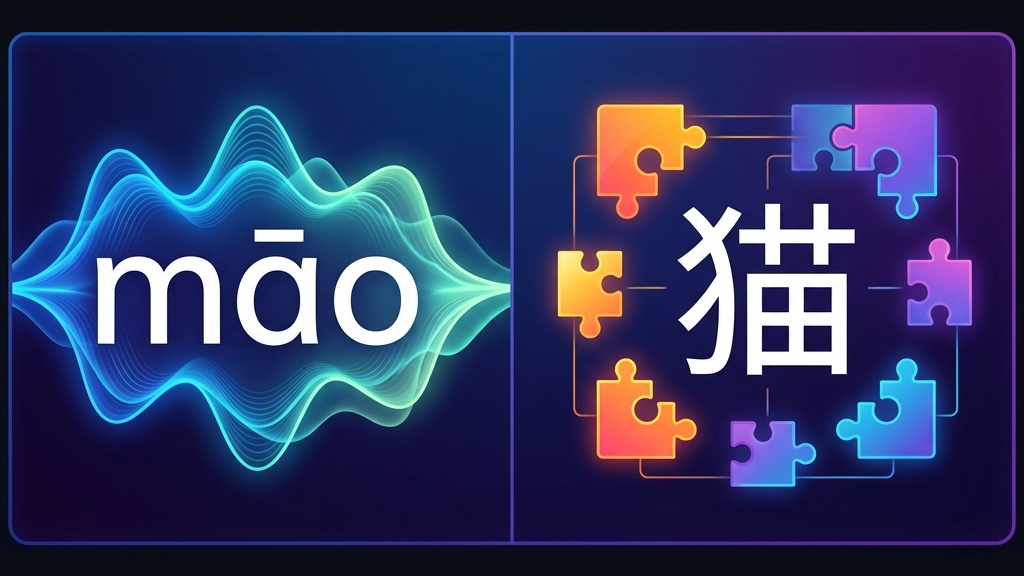
Pinyin tells you exactly how to pronounce a word. It breaks every syllable into an Initial, a Final, and a Tone. When you read "māo," you know the sound starts with your lips closed [m], opens into the vowel [a], glides to [o], and holds a high flat pitch.
Pinyin is precise about pronunciation. It leaves no ambiguity about how a word sounds. But it tells you nothing about what the word means. The syllable "māo" could be 猫 (cat) or part of a longer word. Pinyin does not show you the difference.
Characters: The Meaning Layer
Chinese Characters work the opposite way. The character 猫 contains a radical (犭) that hints at "animal." Another component (苗) offers a clue about pronunciation. But to read the character, you must already know it. Characters do not spell out their sounds the way Pinyin does.
Characters carry history, culture, and nuance. They connect you to thousands of years of written Chinese. A single character can convey layers of meaning that Pinyin cannot.
The Same Sentence in Both
Seeing the two systems side by side makes the difference clear. The sentence "I love you" is written wǒ ài nǐ in Pinyin and 我爱你 in characters. The Pinyin tells you exactly how to say it, with the right sounds and tones. The characters tell you what it means, and they stay the same even for someone whose spoken dialect pronounces them very differently. A reader in Beijing and a reader in Hong Kong see the identical 我爱你, yet would say it in quite different ways. That shared meaning layer is something Pinyin, tied to Mandarin sound, can never provide.
Two Tools, One Language
Pinyin and Characters are not competitors. They are partners. Pinyin gives you access to pronunciation from day one. Characters give you access to meaning, literacy, and the full written world of Chinese.
Most learners start with Pinyin to build a foundation of sound. Over time, Characters become the primary reading system. But Pinyin never disappears. It remains useful for looking up unfamiliar words and for typing Chinese on digital devices.
Use both. Let Pinyin train your ears and voice. Let Characters train your eyes and memory.