There is an uncomfortable truth in the world of Mandarin learning that textbooks rarely state plainly: most foreign learners of Chinese will never reach full character literacy. Not because they lack talent or motivation, but because the sheer scale of the task is unlike anything encountered in learning a European language.
This is not a criticism of learners. It is a realistic assessment of what character mastery demands, and it explains why Pinyin will remain a permanent companion for the vast majority of non-native speakers.
The Mountain That Native Children Climb
To understand the challenge foreign learners face, consider first what Chinese children go through. Character acquisition in China is not a side activity. It is the central pillar of elementary education, consuming more classroom hours than any other subject.
Chinese children begin learning characters around age 6. By the end of first grade, the national curriculum standard requires approximately 400 characters. By the end of sixth grade, the target is around 3,000 characters. The full journey to the 3,500-character threshold, the number the Chinese Ministry of Education defines as the "commonly used" set for functional literacy, typically takes nine years of daily, structured instruction [Ministry of Education, PRC].
This process is not passive. It involves years of repetitive handwriting practice (写字, xiě zì), dictation tests (听写, tīng xiě), radical memorization, and constant reading reinforcement. Chinese educators estimate that a student writes each new character between 20 and 50 times before committing it to long-term memory. Even then, characters that are not regularly encountered in daily reading begin to fade, a phenomenon so common among adult native speakers that it has its own name: 提笔忘字 (tí bǐ wàng zì), "pick up the pen, forget the character."
The Foreign Learner's Steeper Path
Now consider the position of an adult foreign learner. This person does not have nine years of dedicated elementary schooling ahead of them. They do not have a surrounding environment of character-based signage, media, and social interaction reinforcing what they learn. They are often studying part-time, fitting Mandarin alongside a full-time job or other academic commitments.
Research from the U.S. Foreign Service Institute (FSI), which has trained American diplomats in dozens of languages for over seventy years, classifies Mandarin among its "super-hard" languages, the most difficult tier for English speakers. The FSI estimates that achieving professional working proficiency requires approximately 2,200 class hours, compared to 600-750 hours for Spanish or French [U.S. State Department, FSI].
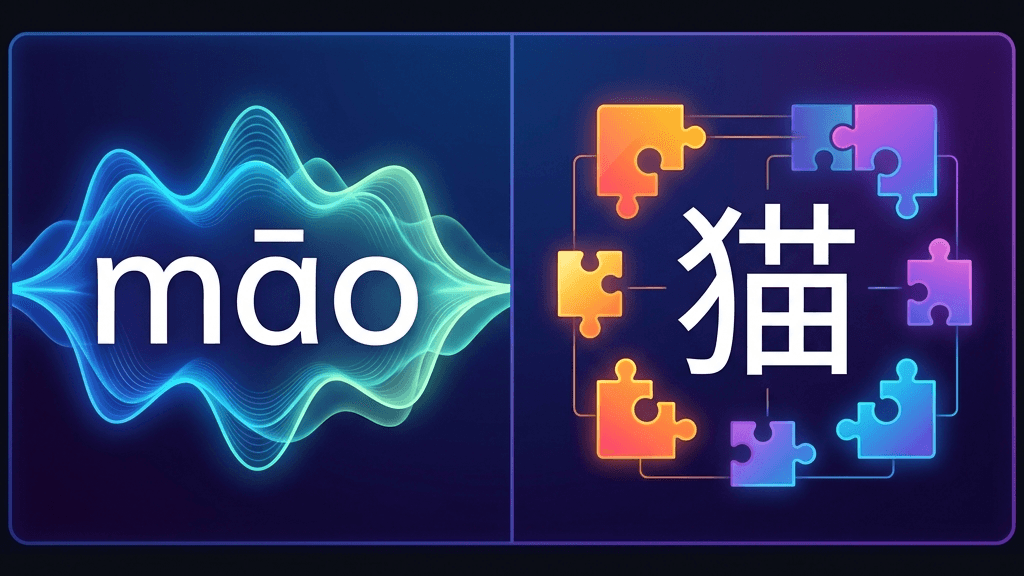
A significant portion of that difficulty comes from the writing system. Unlike alphabetic scripts, where a small set of letters can be recombined to read any word, each Chinese character must be individually memorized. There is no reliable way to "sound out" an unfamiliar character the way you can sound out an unfamiliar English word.
The 2,000-Character Barrier
Studies by the HSK (Hanyu Shuiping Kaoshi) testing organization and various academic researchers suggest that reading a Chinese newspaper with reasonable comprehension requires knowledge of approximately 2,000 to 3,000 characters. The HSK 6 exam, the highest level of the original six-level Chinese proficiency test, requires a vocabulary of around 5,000 words [HSK Official].
Most adult learners plateau well before this threshold. A 2016 study published in the Journal of Chinese Language Teaching found that the average foreign learner enrolled in a university Chinese program in China achieved recognition of approximately 1,200 to 1,800 characters after two to three years of full-time study. Part-time learners outside of China achieved significantly less.
This means that for the majority of foreign Mandarin learners, large portions of written Chinese remain inaccessible without assistance. Pinyin provides that assistance.
Pinyin as a Permanent Bridge
For learners below the 2,000-character threshold, Pinyin is not a crutch; it is a functional necessity. Without it, a learner encountering an unfamiliar character in a text has no way to determine its pronunciation. They cannot look it up efficiently. They cannot ask someone about it without pointing at a screen.
With Pinyin, the same learner can read the pronunciation, understand the tone, look up the meaning, and continue engaging with the text. Pinyin keeps the door open. Without it, unfamiliar characters become walls.
This is why Pinyin annotations (known as "ruby text" in web standards) remain a standard feature in Chinese language textbooks through advanced levels. It is also why tools like Pinyinize exist, to bridge the gap between what a learner can currently read in characters and the full breadth of the Chinese text they want to engage with.
There Is No Shame in the Bridge
The expectation that a learner should eventually "graduate" from Pinyin is well-intentioned but often unrealistic. Professional translators, diplomats, and long-term expatriates in China routinely use Pinyin-assisted tools in their daily work. The goal of language learning is communication, not the performance of unaided character recall.
If Pinyin keeps you reading, listening, and engaging with Mandarin, it is doing exactly what it was designed to do. The bridge is not the problem. The bridge is what gets you across.