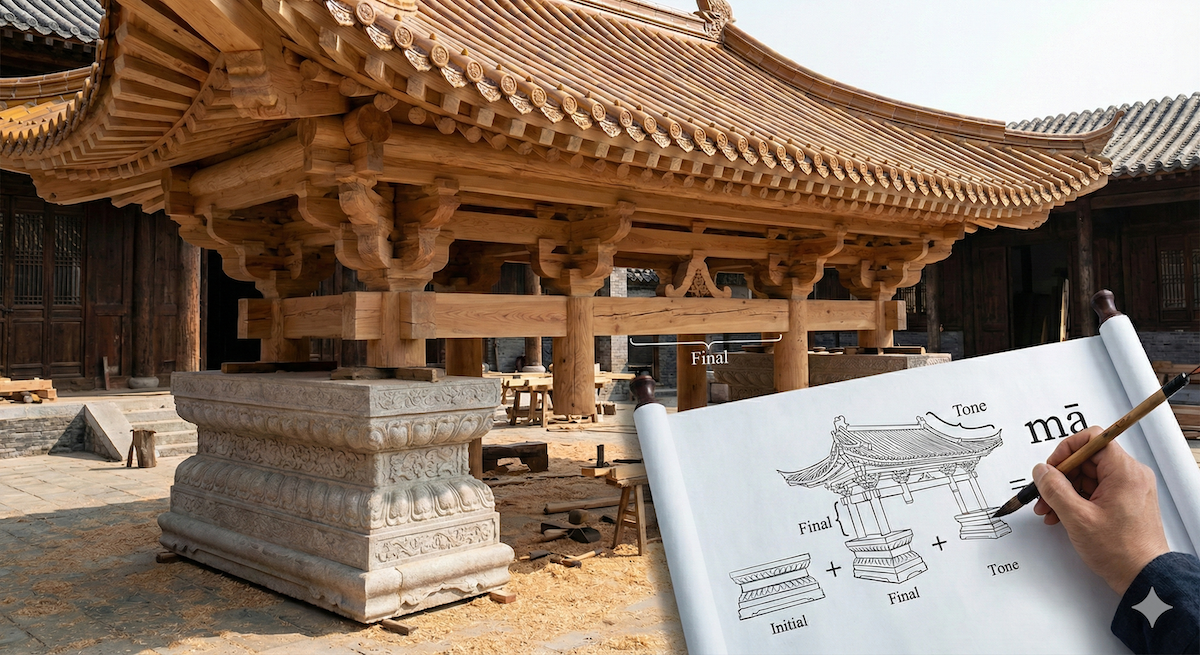
Think of a Pinyin syllable like a masterfully built temple. To stand tall and look right, it requires a foundation, a frame, and a roof.
If you remove the roof, the building is incomplete; if you move the foundation, the structure collapses. In Pinyin, every "block" of sound, which represents one Chinese character, is built using a very strict architectural plan.
Unlike many languages where spelling rules feel like suggestions, Pinyin syllables are tidy, predictable, and remarkably sturdy.
The Building Parts
To master the structure, you must understand these three components:
The Initial (The Foundation): This is the consonant sound that begins the syllable. Place your tongue or lips in position to release the sound. For example, in the syllable mā, the m is the Initial.
The Final (The Frame): This is the vowel sound that follows the Initial. It is the heart and body of the syllable. In mā, the ā is the Final.
The Tone (The Roof): This is the "shape" of the sound. It tells you if your voice should stay high, rise, or fall. The small mark above the vowel in mā acts as the roof, giving the syllable its final character.
Built to Last: The Power of Consistency
One of the most comforting things about Pinyin is its absolute reliability. In some languages, the same letter combination can sound different in every word. Pinyin does not play those games.
Even when a syllable looks unusual at first, like zhī [ʈʂɨ] or qǔ [tɕʰy], it will always be pronounced exactly that way every single time you see it.
Once you learn the "code" for a specific Initial and Final combination, you have unlocked that sound forever. There are no hidden surprises, only a consistent system that rewards your practice with total clarity.
Practice the Build
Let us look at how these consistent building parts combine to create different meanings:
Initial [h] + Final [ǎo] + Tone [falling-rising] = hǎo (Good)
Initial [n] + Final [ǐ] + Tone [falling-rising] = nǐ (You)
Initial [zh] + Final [ōng] + Tone [high-level] = zhōng (Middle)
When the Foundation Is Missing
Not every syllable starts with a consonant. Some are built from the final alone, with no initial at all. Words like ài (爱, love), ān (安, peace), and ōu (欧, Europe) begin straight with the vowel sound, yet they are still complete, legal syllables. In writing, a few of these gain a small helper letter so the word boundaries stay clear, which is why you see yī rather than a bare ī. The blueprint simply allows the foundation to be invisible.
Conclusion
Once you recognize the Initial, Final, and Tone, you can read any Pinyin word in existence. It is a logical system that will make your Mandarin feel like a classic structure: solid, balanced, and precise!