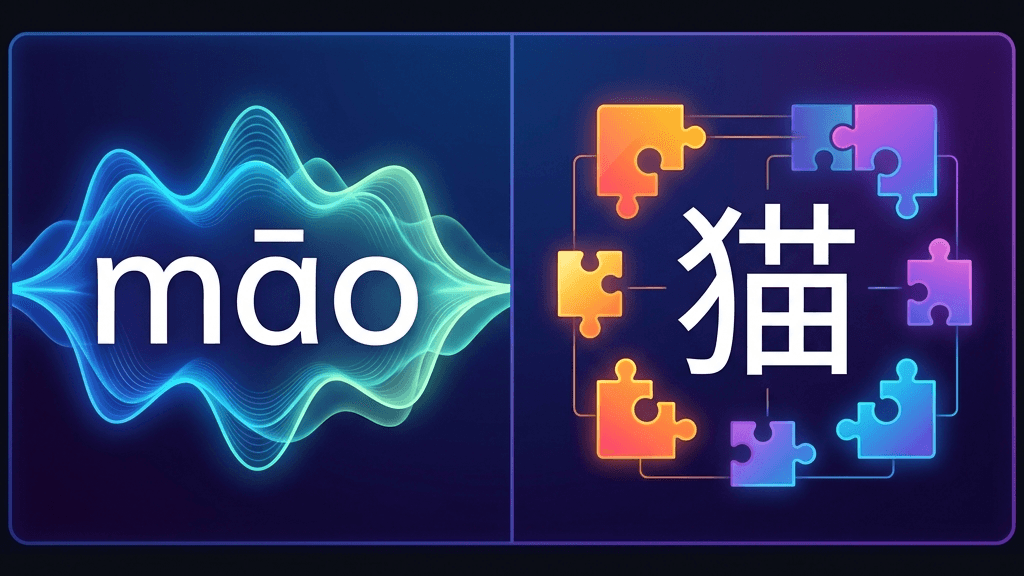
The question of whether Pinyin could replace Chinese characters is one of the most provocative topics in Chinese linguistics. To most Chinese speakers today, the idea seems absurd, even offensive. Characters are not just a writing system; they are a cultural artifact spanning thousands of years. Yet the question is worth examining seriously, because other East Asian nations have already made exactly this kind of shift, and the results are instructive.
The Precedent: Vietnam
For over a thousand years, Vietnam used a Chinese-derived writing system called Chữ Nôm alongside Classical Chinese (Chữ Hán). Vietnamese literature, government records, and religious texts were all written in these character-based scripts.
In the 17th century, Portuguese and French missionaries developed a Latin-based alphabet for Vietnamese called Chữ Quốc Ngữ ("National Language Script"). Initially a tool for religious instruction, it remained a minority system for centuries. Then, during French colonial rule in the late 19th and early 20th centuries, Quốc Ngữ was promoted as the official script. After independence, both North and South Vietnam adopted it as the sole national writing system.
The transition was complete within roughly one generation. Today, virtually no Vietnamese person reads Chữ Nôm. The Latin-based script enabled rapid gains in literacy: Vietnam's adult literacy rate rose from under 10% in the early 20th century to over 95% today [World Bank Literacy Data]. The simplicity of an alphabetic system, where readers can sound out unfamiliar words, played a significant role in this achievement.
The Precedent: Korea
Korea presents an equally compelling case. For centuries, Korean was written using Classical Chinese characters (Hanja). In 1443, King Sejong the Great commissioned the creation of Hangul, a phonetic alphabet specifically designed for the Korean language. Sejong's stated goal was to give common people a writing system they could learn in days rather than years [UNESCO Memory of the World].
Despite elite resistance, scholars dismissed Hangul as a "vulgar" script for centuries, it gradually gained acceptance. South Korea continued to use a mix of Hangul and Hanja through the 20th century, but in 1970, President Park Chung-hee issued a decree to phase Hanja out of official documents and textbooks. North Korea had already abolished Hanja entirely in 1949.
Today, South Korea is functionally a Hangul-only society. Hanja appears in academic contexts and some legal documents, but the vast majority of Koreans never use Chinese characters in daily life. South Korea's literacy rate stands at 98% [World Bank].
The Precedent: Turkey and Others
The pattern extends beyond East Asia. In 1928, Mustafa Kemal Atatürk replaced the Arabic script used for Ottoman Turkish with a modified Latin alphabet. The transition was enforced over just a few years. Literacy rates in Turkey climbed from approximately 10% to over 90% within a few decades [World Bank].
Indonesia, Malaysia, and many Central Asian republics have also transitioned between scripts, sometimes more than once, demonstrating that writing system changes, while politically charged, are historically common and practically achievable.
The Chinese Context
China itself seriously explored romanization in the early and mid-20th century. Prominent reformers, including Lu Xun (鲁迅) and Mao Zedong, publicly supported the idea of eventually replacing characters with a phonetic script.
The creation of Pinyin in 1958 was originally conceived as a step toward this goal, not merely as a pronunciation aid. However, the government ultimately decided to retain characters and position Pinyin as an auxiliary system. The reasons were both practical and ideological:
- Homophone density: Mandarin has far more homophones than Vietnamese or Korean. The syllable "shì" maps to over 30 common characters. A purely phonetic script would create massive ambiguity in written communication.
- Dialect diversity: China's many regional languages (Cantonese, Shanghainese, Hokkien, etc.) share the same character system but have different pronunciations. Characters provide a written unity that a Mandarin-based phonetic script could not offer to non-Mandarin speakers.
- Cultural identity: Characters are deeply embedded in Chinese cultural identity, art (calligraphy), and history. Abandoning them would mean severing access to millennia of historical texts for the general population.
The Counterarguments
These objections are serious but not necessarily permanent. Scholars who argue for romanization point out several things:
- Vietnamese also has tonal distinctions and manages them with diacritics, the same approach Pinyin uses.
- Context resolves most homophone ambiguity in spoken Mandarin already. Written Pinyin with word spacing and context could do the same, just as English handles its own homophones ("there/their/they're") through context.
- The dialect unity argument has weakened as Mandarin (Pǔtōnghuà) has become increasingly dominant through national media and education. Over 80% of China's population now speaks Mandarin [Ministry of Education, PRC].
- Technology has already made Pinyin the de facto input layer for characters. Most Chinese people type Pinyin and select characters, meaning they already depend on phonetic encoding for written communication.
The Realistic Assessment
Will Pinyin replace Hanzi in the foreseeable future? Almost certainly not. The Chinese government has no plans to pursue romanization. Public sentiment overwhelmingly favors the preservation of characters. The cultural, artistic, and historical value of Hanzi is immense.
But the question itself is not absurd. History shows that writing system transitions, even radical ones, can happen within a single generation when political will and practical need align. Vietnam, Korea, and Turkey all prove that a society can shift from a complex script to a simpler one with dramatic improvements in literacy and accessibility.
Whether China will ever reach that tipping point is a matter of political and cultural evolution, not linguistic impossibility. For now, Pinyin and Hanzi coexist (one carrying the sounds, the other carrying the meaning) in a partnership that shows no signs of ending.