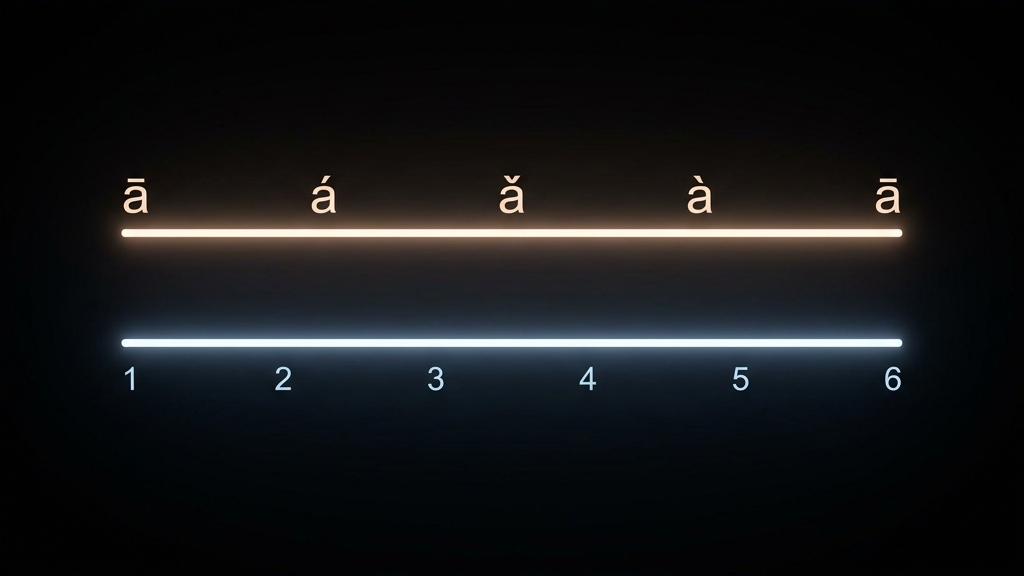
Hanyu Pinyin was designed for one specific language: Standard Mandarin (Pǔtōnghuà). It does not represent the sounds of Cantonese, Hokkien, Shanghainese, or any of the hundreds of other Chinese languages and dialects. Yet many people assume that "Pinyin" is a universal system for all Chinese. It is not.
Cantonese (spoken by roughly 85 million people, primarily in Guangdong province, Hong Kong, and Macau) has its own romanization systems. Comparing them with Pinyin reveals how different two Chinese languages can be, and why one phonetic system cannot serve them all.
Why Cantonese Needs Its Own System
Cantonese and Mandarin share the same character set but differ dramatically in pronunciation. The character 人 is "rén" in Mandarin but "jan4" in Cantonese. The character 食 is "shí" in Mandarin but "sik6" in Cantonese. These are not minor accent differences; they are distinct phonological systems with different consonants, vowels, and tones.
Mandarin has 4 tones (plus a neutral tone). Cantonese has 6 tones in most modern analyses (historically 9, with 3 entering tones that are distinguished by vowel length rather than pitch contour). Pinyin's four tone marks cannot represent Cantonese's tonal system, which is why Cantonese romanization uses numbers instead [LSHK Jyutping].
The Main Cantonese Romanization Systems
Unlike Mandarin, which has one dominant romanization standard (Pinyin), Cantonese has several competing systems:
1. Jyutping (粤拼)
Developed in 1993 by the Linguistic Society of Hong Kong (LSHK), Jyutping is the most systematic and linguistically rigorous romanization for Cantonese. It uses numbers 1-6 for tones and has consistent, unambiguous letter-to-sound mappings.
Example: 你好 = nei5 hou2
Jyutping is increasingly used in academic contexts, language learning apps, and digital tools. It is the closest Cantonese equivalent to Pinyin in terms of standardization and official backing.
2. Yale Romanization
Developed in the 1960s at Yale University, this system was designed for American students learning Cantonese. It uses diacritics and the letter "h" to mark tones, making it more visually intuitive for English speakers but less precise than Jyutping.
Example: 你好 = néih hóu
Yale remains popular in older textbooks and among learners in the United States, but it is gradually being superseded by Jyutping in newer materials.
3. Sidney Lau Romanization
Created by Sidney Lau for the Hong Kong government's Cantonese courses in the 1970s. It uses superscript numbers for tones and was widely used in Hong Kong's civil service language programs. It is now largely historical.
4. Canton Romanization (广州话拼音方案)
Published by the Guangdong Provincial Education Department in 1960. Modeled on Pinyin's structure, it uses numbers for tones and attempts to align with Mandarin Pinyin conventions where possible. It is used primarily in mainland Guangdong, not in Hong Kong [Guangdong Romanization].
Head-to-Head: Pinyin vs. Jyutping
| Feature | Pinyin (Mandarin) | Jyutping (Cantonese) |
|---|---|---|
| Language | Standard Mandarin | Cantonese |
| Tones | 4 + neutral (diacritics) | 6 (numbers 1-6) |
| Final consonants | -n, -ng only | -n, -ng, -m, -p, -t, -k |
| Standardization | ISO 7098, UN, PRC law | LSHK standard (Hong Kong) |
| International recognition | Global | Limited to Cantonese studies |
| Digital input support | Universal | Growing (supported on iOS, Android) |
One of the most notable differences is that Cantonese preserves final stop consonants (-p, -t, -k) that Mandarin lost centuries ago. This makes Cantonese phonology richer and its romanization necessarily more complex.
The Fragmentation Problem
The biggest challenge facing Cantonese romanization is the lack of a single dominant standard. Mandarin learners worldwide use Pinyin; there is no debate. But Cantonese learners must choose between Jyutping, Yale, and others, and materials are split across systems.
This fragmentation makes Cantonese harder to learn from a resource perspective. Dictionaries, textbooks, and apps may use different systems, forcing learners to either commit to one or learn to read multiple romanizations.
The trend, however, is clearly toward Jyutping. Major Cantonese dictionaries like CantoDict and apps like Pleco now default to or prominently feature Jyutping. The Hong Kong government's official Cantonese transcription resources increasingly align with LSHK standards.
What This Means for Mandarin Learners
If you know Pinyin and are curious about Cantonese, be prepared for a significantly different system. The letters may look similar, but the sound mappings, tone system, and syllable structures are different enough that you cannot simply transfer your Pinyin knowledge.
However, understanding that romanization is a tool, not the language itself, transfers perfectly. The principle you learned with Pinyin (phonetic notation helps you access sounds, but characters carry the meaning) applies equally to Jyutping and Cantonese.