For decades, Pinyin served two primary roles: teaching pronunciation to learners and enabling digital input for native speakers. Both roles were relatively static. You learned the system, used it, and it did not change much from year to year.
Artificial intelligence is changing this. AI is not replacing Pinyin; it is expanding what Pinyin can do, and in some cases, quietly reducing how much humans need to interact with it directly. The future of Pinyin is being reshaped by technologies that did not exist a decade ago.
AI-Powered Input: Beyond Simple Matching
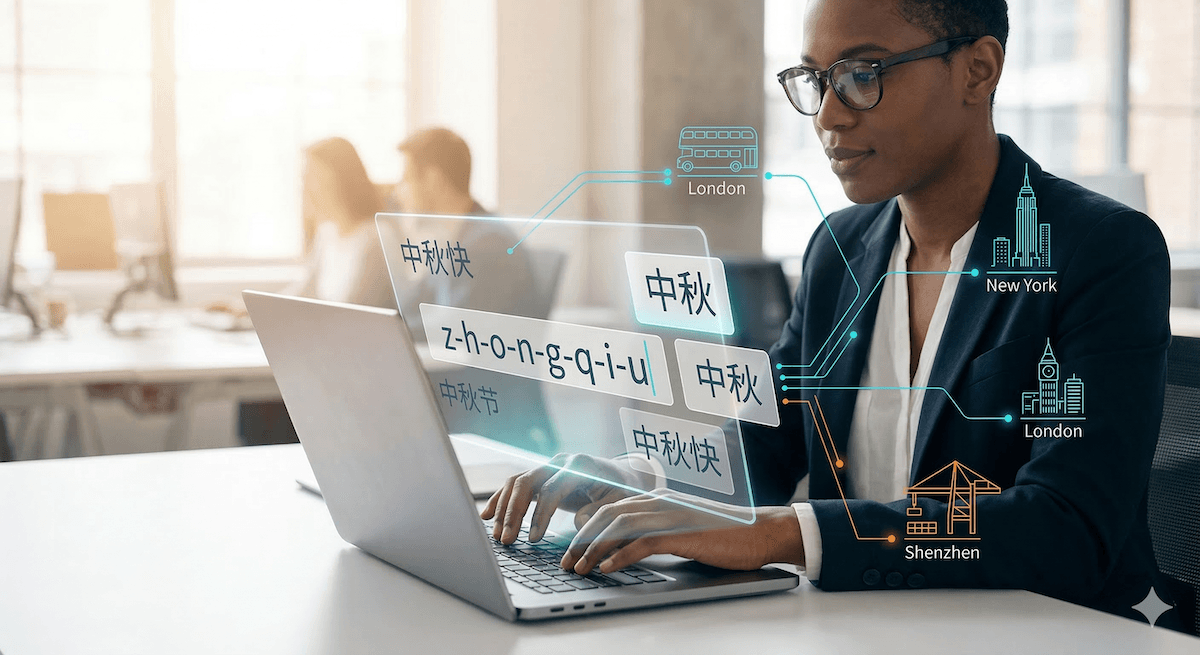
Traditional Pinyin input methods worked by matching typed syllables to a static dictionary of character candidates. You typed "zhongguo," and the system offered 中国 from a lookup table.
Modern AI-powered input methods work differently. They use deep learning models trained on billions of sentences to predict not just individual words but entire phrases and sentences from context. Sogou, Baidu, and Apple's native Chinese keyboard all use neural language models that can:
- Predict the next word before you finish typing it.
- Disambiguate homophones based on the surrounding sentence.
- Correct common Pinyin typos and abbreviations.
- Adapt to individual users' vocabulary and writing style over time.
This means the Pinyin input experience is becoming less about the user selecting the right character and more about the AI getting it right automatically. For common phrases, the accuracy of modern Pinyin input engines exceeds 95% for first-candidate selection [Microsoft Research NLC].
Speech Recognition: Bypassing Pinyin Entirely
Voice input on smartphones and smart speakers converts spoken Mandarin directly to characters, bypassing the Pinyin typing step altogether. Services like Baidu's, iFlytek's, and Apple's Chinese voice engines now transcribe standard Mandarin with very high accuracy in quiet conditions, reliable enough to make voice a practical alternative to typing for many everyday messages.
As voice interfaces become more reliable and socially acceptable, some portion of text entry that currently goes through Pinyin keyboards will shift to direct speech input. This does not eliminate Pinyin; you still need it for quiet environments, precise editing, and situations where speaking is impractical. But it does reduce the number of daily Pinyin interactions for the average user.
AI Pinyin Conversion: From Text to Annotated Reading
One of the most promising AI applications for Pinyin is automated character-to-Pinyin conversion with contextual accuracy. This is the core technology behind tools like Pinyinize.
The challenge is polyphonic characters (多音字, duōyīnzì). The character 了 is pronounced "le" in some contexts and "liǎo" in others. The character 行 can be "xíng" or "háng." Traditional rule-based converters relied on dictionary lookups and frequency tables, which failed in ambiguous cases.
AI models trained on large annotated corpora can analyze the surrounding context (the grammar, the semantic meaning, the common collocations) to select the correct pronunciation with accuracy rates that approach native-speaker performance. This makes Pinyin annotations more trustworthy than ever, which in turn makes Pinyin-assisted reading more viable for intermediate learners working with authentic Chinese texts.
Machine Translation and Pinyin as an Intermediate Layer
Large language models (LLMs) like those powering modern translation services process Chinese text internally using tokenization schemes that often map to or through phonetic representations. While the details are proprietary, researchers have shown that phonetic awareness, including Pinyin-like encoding, improves machine translation quality for Chinese [ACL Anthology].
This means Pinyin is not just a human-facing tool anymore. It is becoming part of the computational infrastructure that AI systems use to process Chinese. Whether explicitly or implicitly, the phonetic layer that Pinyin represents is embedded in how machines understand and generate Chinese text.
Educational AI: Personalized Pinyin Learning
AI tutoring systems are beginning to use speech recognition and phonetic analysis to provide real-time feedback on Mandarin pronunciation. These systems compare a learner's spoken output against a Pinyin reference and identify specific errors: wrong tones, incorrect initials, or imprecise finals.
Apps leveraging this technology, such as those using speech-to-Pinyin comparison engines, can offer the kind of granular pronunciation feedback that was previously available only from a human tutor. As these systems improve, Pinyin becomes the reference standard against which pronunciation quality is measured, reinforcing its role as the authoritative phonetic framework for Mandarin.
The Risk: Passive Pinyin Dependence
There is a downside to AI's growing role. As input methods get smarter and voice recognition improves, users may interact with Pinyin more passively. Instead of deliberately thinking about the Pinyin spelling of a word, they type a few letters and accept whatever the AI suggests.
For native speakers, this may accelerate the "character forgetting" phenomenon already underway. For learners, there is a risk that AI-assisted input becomes a bypass for genuine phonetic understanding, selecting characters from suggestions without truly internalizing the Pinyin.
The tool becomes most valuable when the user actively engages with it. Pinyin's future utility depends not just on how smart the AI becomes, but on how deliberately humans continue to use the system as a foundation for real linguistic knowledge.
Pinyin Is Not Going Anywhere
AI will not make Pinyin obsolete. If anything, the opposite is happening. Pinyin is becoming more deeply embedded in technology, as an input layer, an annotation system, a pronunciation reference, and a computational tool. The interface may change (typing, speaking, or letting AI handle it), but the underlying phonetic framework remains essential.
The future of Pinyin is not about Pinyin itself changing. It is about everything around it getting smarter while Pinyin continues to do what it has always done: make the sounds of Mandarin accessible to anyone willing to learn them.