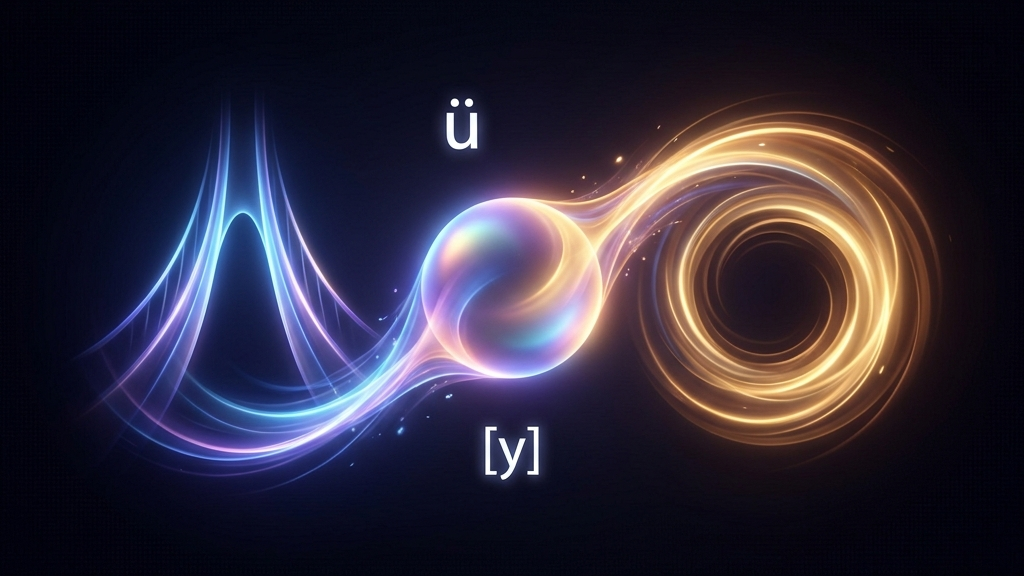
The vowel 'ü' is the most unusual sound in Mandarin Pinyin. It does not exist in many of the world's languages, which makes it both fascinating and challenging. It is a high, front, rounded vowel. That means your tongue goes to the position for 'i', but your lips form the shape of 'u'.
The Magic Combination
Here is the trick. Say 'i' first. Feel your tongue rise high toward the front of your mouth. Now, without moving your tongue at all, round your lips tightly as if you were saying 'u'. That is 'ü'. Your tongue says 'i' while your lips say 'u'. Two shapes at the same time.
Physical Positioning
To produce a precise 'ü' sound:
- Lips: Round them tightly and push them forward, just like 'u'.
- Tongue: Raise the front of your tongue high toward the hard palate, just like 'i'. The tip touches the back of your lower front teeth.
- Mouth: Nearly closed. The opening is small and round.
- Key point: The tongue position is 'i'. The lip position is 'u'. Both happen simultaneously.
Where the Two Dots Appear
The two dots above 'ü' (called an umlaut or trema) appear in Pinyin after the initials 'l' and 'n'. For example: lǜ (Green) and nǚ (Woman). After the initials 'j', 'q', 'x', and 'y', the dots are dropped for simplicity, but the sound remains 'ü'. So jū, qù, xǔ, and yǔ all contain the 'ü' sound, even though they are written with 'u'.
Examples and Practice
Practice these words slowly, checking both your lip rounding and tongue height:
- yǔ (Rain): Lips round, tongue high and forward.
- lǜ (Green): The two dots remind you this is 'ü', not 'u'.
- qù (To go): No dots written, but the sound is still 'ü'.
The ü Family of Finals
The ü rarely works alone; it also builds a small family of finals. It joins with e to make üe (xué, to study; yuè, moon), with an to make üan (yuàn, wish), and with n to make ün (jūn, army). In every one, the front-rounded ü position is the anchor, even when the spelling hides the dots after j, q, x, and y. Get the standalone ü right and this whole group of common, useful syllables falls into place with it.
Why 'ü' Deserves Extra Attention
This vowel is the most commonly mispronounced sound in Mandarin. Learners often substitute 'u' because the written form can look identical. But 'u' and 'ü' are completely different vowels. Confusing them changes meaning. The word lù means "road," but lǜ means "green." Train your mouth to hold the 'i' tongue with 'u' lips, and this special vowel will become second nature. (hear it on the Pinyin Chart)