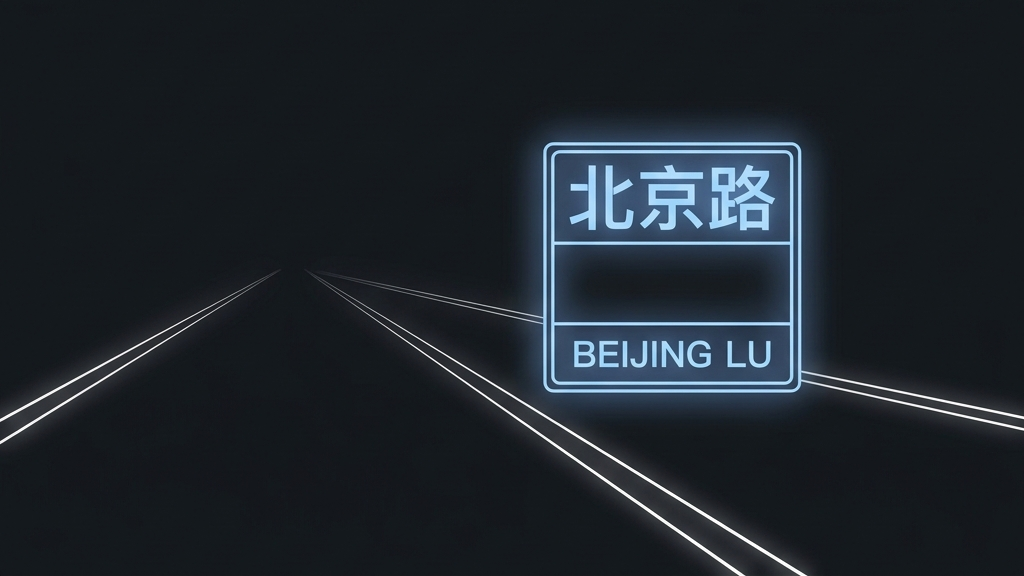
If you have ever walked through a Chinese city, you may have noticed something familiar beneath the characters on road signs: Latin letters. That is Pinyin, and its presence on public signage is not accidental. It is the result of national legislation that has shaped how China presents itself to both its own citizens and the world.
The Legal Mandate
In 2000, the People's Republic of China passed the Law of the National Common Language and Characters (国家通用语言文字法). Article 18 of this law explicitly states that Hanyu Pinyin is the standard romanization system for Chinese and shall be used in areas where Chinese needs to be written in the Latin alphabet [Full text, gov.cn].
In practice, this means that major road signs, highway markers, railway station names, and airport signage across China must display Pinyin alongside Chinese characters. The standard is maintained by the National Language Commission and enforced through municipal regulations.
How Pinyin Appears on Signs
On most Chinese road signs, Pinyin appears without tone marks. The convention follows the national standard GB/T 16159, which specifies that geographical names and road names use Pinyin with the first letter of each word capitalized and no tone diacritics.
For example:
- 北京路 → Běijīng Lù (with tones in textbooks) → Beijing Lu (on signs)
- 长安街 → Cháng'ān Jiē → Chang'an Jie
- 南京东路 → Nánjīng Dōng Lù → Nanjing Dong Lu
Generic terms like 路 (lù, road), 街 (jiē, street), and 桥 (qiáo, bridge) are transliterated into Pinyin rather than translated into English. So you will see "Beijing Lu" rather than "Beijing Road", a deliberate policy choice that preserves the Chinese linguistic identity of the place name.
The Exception: International Cities
In highly international cities like Shanghai, Hong Kong, and Shenzhen, some signage includes English translations alongside or instead of Pinyin. Metro systems in particular often use English glosses ("East Nanjing Road" instead of "Nanjing Dong Lu") to assist foreign travelers.
This creates an interesting tension. Purists argue that Pinyin should always be used for consistency and to reflect the official standard. Pragmatists counter that English translations are more useful for international visitors who do not know that "Lu" means "Road."
The 2022 revision of China's national signage standards attempted to resolve this by recommending a dual-line format: Pinyin on one line, an English gloss on another, beneath the Chinese characters. Implementation remains inconsistent across municipalities.
Pinyin and Navigation Technology
Beyond physical signs, Pinyin is essential for digital navigation. Mapping services like Baidu Maps, Amap (Gaode), and even Google Maps rely on Pinyin romanizations for place names when rendering results for non-Chinese users. When your GPS pronounces a Chinese street name, it is reading Pinyin.
The United Nations Group of Experts on Geographical Names (UNGEGN) officially adopted Hanyu Pinyin as the standard romanization for Chinese geographical names in 1977 and reaffirmed this position in subsequent conferences [UNGEGN]. This means that international maps, atlases, and databases worldwide use Pinyin, not Wade-Giles or other older systems, for Chinese place names.
What This Means for Travelers and Learners
For Mandarin learners traveling in China, basic Pinyin literacy is immediately practical. You do not need to read Chinese characters to identify street names, metro stations, or highway exits if you can read the Pinyin underneath them.
However, remember that sign Pinyin omits tone marks. "Chang'an Jie" does not tell you it is "Cháng'ān Jiē" (second tone, first tone, first tone). If you want to pronounce the name correctly or ask for directions, you will need to recall the tones from memory or a reference tool.
Pinyin on road signs is one of the most visible examples of how this phonetic system has grown far beyond the classroom. It is embedded in national law, international standards, and the digital infrastructure that connects China to the rest of the world.