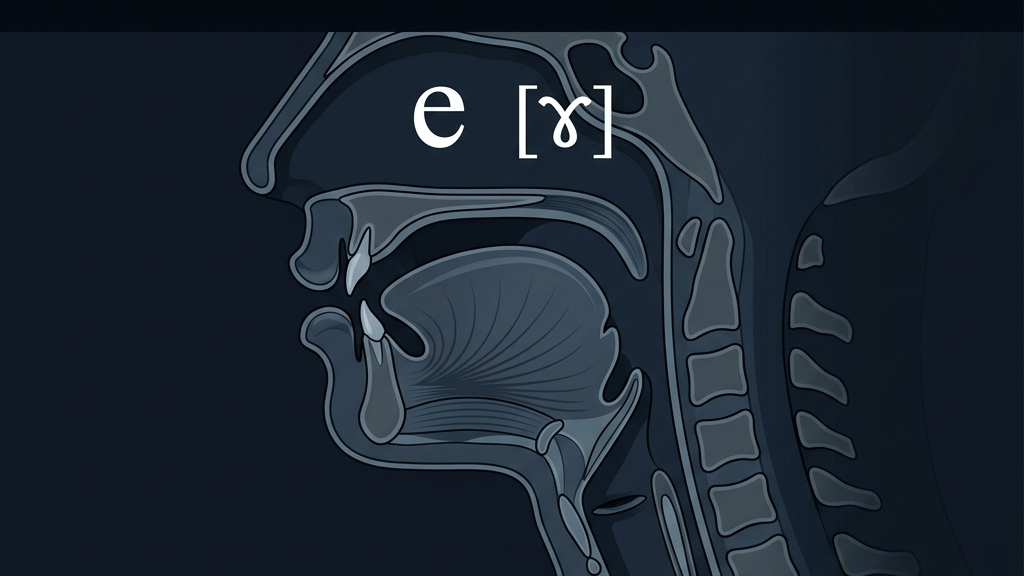
The Mandarin vowel 'e' is one of the most surprising sounds for new learners. It does not match any vowel you may already know. It is produced deep in the throat with a unique tongue position that takes deliberate practice to master. (hear it on the Pinyin Chart)
The Smile That Does Not Smile
Here is a helpful image. Pull the corners of your mouth slightly back, as if you are about to smile. But do not actually smile. Instead, keep your lips relaxed and slightly parted. This half-smile position is the starting point for the Mandarin 'e'.
Physical Positioning
The Mandarin 'e' is produced with unrounded lips and the tongue pulled back. Here is how to form it:
- Lips: Unrounded and slightly spread. They should not push forward at all.
- Mouth: Open to a medium degree, similar to 'o' but without any rounding.
- Tongue: Pull the body of your tongue back toward your throat. Raise it to a mid-height, so it hovers between the roof and floor of your mouth.
- Throat: The sound resonates from the back of your oral cavity. You should feel the vibration deep inside your mouth, not at the front.
Examples and Practice
The standalone 'e' appears in many common words. Try these:
- hē (To drink): Feel the sound originating deep in your mouth.
- kè (Guest): The tongue stays back even as the tone falls.
- gē (Song): Hold the tongue position steady through the high, level tone.
A Critical Distinction
The letter 'e' in Pinyin represents different sounds depending on its context. When it stands alone or after certain initials, it is the deep 'e' described here. But inside compound finals like 'ei' or 'en', the 'e' shifts to a more forward position. For now, focus on mastering this standalone sound. The variations will come in later lessons.
A Shortcut to the Sound: Unround Your o
If the half-smile image does not click, try this instead. Say a rounded o and hold it. Now, without moving your tongue at all, spread your lips flat and let the rounding fall away. The sound that comes out is the Mandarin e. That is actually what the e is: an o made with the lips unrounded, the tongue still pulled back and sitting mid-height. Switching the rounding on and off between o and e is a quick way to lock the position into your muscle memory.
Why This Sound Matters
The vowel 'e' is the sound that most clearly separates Mandarin from other languages. It requires you to use the back of your mouth in a way that feels unfamiliar at first. But once you find it, you will notice it everywhere in spoken Mandarin. It is one of the most frequently used vowels in the language.